The Woodcutter's Family in Poverty
Hansel and GretelThe Woodcutter's Family in Poverty is more than a hardship in the background: famine makes food a question of survival, exposes the children to decisions made by adults, and propels them into the forest twice. The story’s ending reverses that deprivation when Hansel and Gretel bring home precious stones and pearls, so the household that once could scarcely feed its members is no longer left at the mercy of need.
Poverty and the First Abandonment
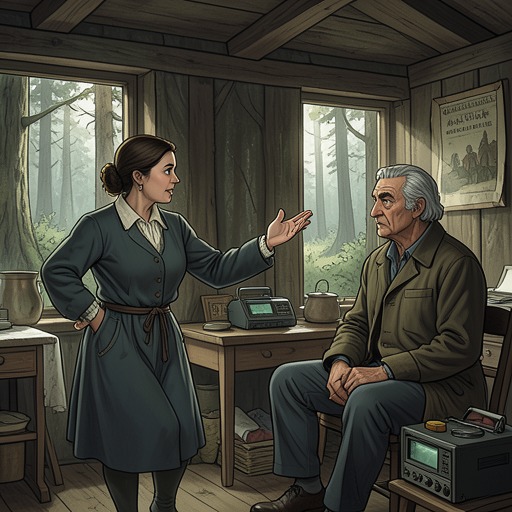
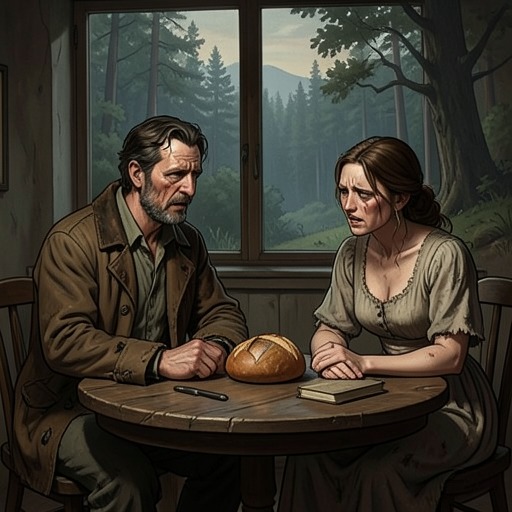
The Woodcutter is poor and has two children, Hansel and Gretel. Their mother has died, and the Woodcutter has remarried. When famine devastates the region, the family has almost nothing to eat. The Stepmother argues that four people cannot survive another winter and proposes taking the children deep into the forest with a piece of bread each, then leaving them there. The Woodcutter objects because he loves his children and knows that hunger or wild animals may kill them, but the Stepmother persists until he agrees.
The children overhear the plan. Hansel responds to their peril by secretly going into the garden at night to fill his pockets with White Pebbles. As the family walks into the forest the next morning, he drops them one by one, making a route back. The adults leave the children beside a fire, telling them to wait while they work. A branch tied to a tree makes a sound like the Woodcutter’s axe, concealing that the parents are not returning. After dark, Hansel waits for the moon; its light reveals the pebbles as a path home. Their return briefly reunites the family, and the Woodcutter is glad to see them, though the Stepmother is furious.
Renewed Hunger and Greater Danger
The reunion does not end the deprivation. After a short time, a famine worse than the first again devastates the region. The Woodcutter does not want to part from his children, but the Stepmother persuades him that abandonment is the only solution. This time she locks the door so Hansel cannot go outside to collect White Pebbles. He instead drops the Bread Crumbs given to him for the journey, but birds eat them all. The failed trail makes the difference between the children’s two journeys plain: the first had a way back, while the second leaves them unable to find the exit from the dark, dense forest.
After wandering hungry and afraid for many hours, Hansel and Gretel reach a clearing and find The candy house. Its chocolate roof, marzipan walls, candy windows, nougat doors, and path of sweets turn food into a tempting substitute for the provisions their family lacked. The children begin eating before they realize that the Witch has come out to meet them. She captures them and reveals the threat behind the apparent abundance: she intends to eat Hansel, while making Gretel help her and waiting for her brother to grow fat enough.
From Food as Threat to Material Security
The Witch’s house makes the story’s food motif more dangerous. At home, famine makes food scarce; in the forest, the edible house draws the starving children into captivity, and the Witch treats food as a means of controlling Hansel’s body. She locks him in a small room and checks whether he is getting fat by asking him to extend a finger through the bars. Because she is short-sighted, Gretel devises a way for him to offer a chicken bone instead, keeping him from being judged ready to eat for a time.
When the Witch tires of waiting, she lights the Oven and orders Gretel to check whether it is hot. Gretel recognizes that the instruction is a trap, pretends not to understand how to enter, and gets the Witch to demonstrate. She shuts the heavy door behind her. The Witch dies in her own Oven, and Gretel frees Hansel from his confinement. The children’s survival depends not on a secure supply of food but on observing the danger and acting together against the person who controls it.
Return and Reversal
In the Witch’s house, the children find bags filled with precious stones and pearls. They fill their pockets and leave the forest; after walking without resting, they reach the Woodcutter’s home. The Woodcutter is overjoyed and tells them that the Stepmother has died and will never hurt them again. He has regretted abandoning the children every day since doing so.
Hansel and Gretel empty their pockets before their astonished father. The treasure changes the family’s material circumstances: the Woodcutter will never again have to suffer want. That ending contrasts with the earlier famines and the adults’ repeated claim that the children must be sacrificed for the household to survive. The story resolves the crisis through the children’s return with wealth, after they have endured both hunger and the Witch’s attempt to turn them into food.